


Guides · August 2026 · 2 min read
How to behave in a room where music is happening.
Ten small things that make the difference between being a guest and being an audience. None of them are about music.
Culture · June 2026 · 2 min read
Three strings, a camel-skin face, a body carved from one piece of wood, and a bass line that has not changed in three hundred years.
The guembri is a three-string bass lute with a body hollowed from a single block of wood, a face of stretched camel skin, and a neck with no frets and no markings of any kind. It is the instrument at the centre of Gnawa music, it is played by the maâlem who leads the ceremony, and almost everything about its construction is decided by what it has to do at four in the morning.
The strings are goat gut, thick, and tuned low and loose. They are plucked with the index finger of the right hand while the same hand strikes the skin with the thumb or the heel, which means the instrument is simultaneously the bass and part of the percussion. Once you have heard that, you cannot unhear it — half of what sounds like a drum in a Gnawa recording is the maâlem’s right hand hitting the front of his own instrument.
There are no frets because the pitches are not equal-tempered and because the player is not looking. The left hand knows where it is going by distance, and the distances are learned by repetition over years. Handing a guembri to a guitarist produces the same result every time: an immediate competence with the rhythm and a complete inability to land the pitch.
The body is carved rather than built, which is unusual for a lute and which matters for the sound. There are no seams, so the whole box resonates as one piece, and the low notes have a woolly, felt-covered quality that a built body does not produce. The skin is tacked, not glued, and it is tightened by warming it — you will see maâlems holding the face of the instrument over a brazier between sections.
The metal rings on the top of the neck are not decoration. They buzz sympathetically, in the same family of ideas as the mirlitons on a West African balafon, and they are the reason a single guembri carries over a room of sixty people and twelve pairs of qraqeb without amplification.
What has not changed is the repertoire the instrument exists to play — a body of rhythms and songs carried north across the Sahara with the enslaved men who became the first Gnawa musicians in Morocco. The instrument was built for that job and it is still doing it, which is a longer service record than most technology manages.
Guides · August 2026 · 2 min read
Ten small things that make the difference between being a guest and being an audience. None of them are about music.
Essays · May 2026 · 2 min read
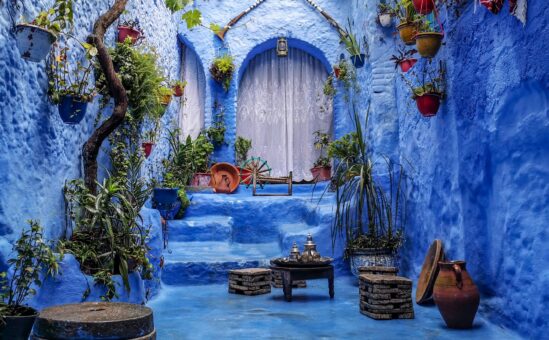
Between four in the afternoon and ten the next morning it is a different town. On staying two nights in a place designed to be seen in five hours.

Fieldwork · April 2026 · 2 min read
A desert blues band, a visiting rhythm section from Lisbon, and a room with no isolation. Notes from a session that should not have worked.